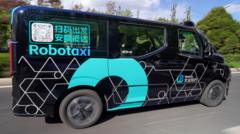
Emergence of Robotaxis in China
In Beijing's Yizhuang district, autonomous vehicles are becoming increasingly prevalent. As these driverless cars navigate the bustling streets, they share the road with conventional vehicles and autonomous delivery vans. This district is a testing ground for companies like Baidu, WeRide, and Pony.ai, which are operating commercial robotaxi services within restricted areas.
Ordering a robotaxi is a straightforward process using an app. Once booked, a driverless vehicle arrives to pick up passengers, who confirm their destination on a touchscreen. The car then seamlessly blends into the complex traffic, maneuvering around various road users with ease. While the technology is still under development, a key question remains: can Chinese companies replicate their electric vehicle (EV) success in the global robotaxi market?
China's Advantage in Autonomous Driving
China's existing industrial ecosystem, which propelled it to become the world's largest EV market, is advantageous for its autonomous driving industry. Unlike Tesla, which develops much of its technology internally, China's self-driving sector comprises a network of companies. Major car manufacturers like BYD, Chery, Geely, and SAIC produce the vehicles, while specialized firms focus on software development.
Autonomous vehicles utilize similar components to electric cars, such as batteries, sensors, chips, and onboard computers. These established supply chains enable rapid technology development at reduced costs. Kyle Chan, a Brookings Institution fellow, notes the unmatched pace of innovation in China's EV industry, emphasizing the interconnected tech ecosystems that drive progress.
The Role of Government Policy and Diverse Driving Conditions
Government initiatives have facilitated the testing of autonomous technology on public roads in several cities. Additionally, China's complex driving conditions provide valuable data to enhance software capability. "The traffic environment here in China is very complex," says Maeve Zhang, WeRide's chief marketing officer, highlighting the diverse road users that contribute to data collection.
However, expanding into international markets presents challenges. Different regions pose unique environmental conditions that could hinder technology deployment. For instance, extreme temperatures in the Middle East, heavy rainfall in Southeast Asia, and harsh winters in Switzerland could impact autonomous vehicle performance.
Global Expansion and Competition
Chinese companies are rapidly expanding their global presence. The main competitor, Waymo, Alphabet's robotaxi business, leads in the U.S. market with established services. Other companies like Amazon's Zoox and Tesla are expanding more cautiously, while Uber has ceased its autonomous vehicle development, opting instead to partner with Chinese firms to access a broader customer base.
Despite their manufacturing cost advantages, Chinese companies face competition from Waymo, which has honed its customer service and app technology over the years. Tu Le, founder of Sino Auto Insights, suggests that Waymo offers a superior user experience compared to competitors.
Regulatory and Safety Challenges
Safety remains a significant concern in the deployment of robotaxis. Earlier this year, Baidu's Apollo Go service experienced a software malfunction, stranding about 100 robotaxis in Wuhan. The incident highlighted how technical failures could undermine public trust.
Similar challenges have arisen in other regions. General Motors recently shut down its robotaxi division, Cruise, following regulatory issues after a crash in California. These incidents underscore the complexities of operating robotaxis compared to traditional car manufacturing or ride-hailing platforms.
Further complicating international expansion, robotaxis generate extensive mapping and location data, raising national security concerns abroad.
The Future of Robotaxis
Despite these challenges, companies like WeRide report positive regulatory developments in China and some international markets. Chan believes that China's focus on creating a high-tech, AI-powered economy aligns with its strengths in batteries, EVs, and related technologies.
Ultimately, the global expansion of Chinese robotaxis will depend on overcoming regulatory, safety, and geopolitical hurdles while leveraging their technological advancements.
Source: Original Article