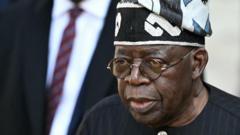
Allegations of a Fraudulent Agency
The President of Nigeria has initiated a thorough investigation into allegations that a fraudulent agency was established within his office, purportedly receiving public funds amounting to $950,000 (£700,000). The agency in question, the Presidential Foreign Intervention Promotion Council (PFIPC), is alleged to have been created through a forged letter from the president's chief of staff.
Police Pursuit and Accusations
The police have launched a search for Adeniyi Adeyemi Matthew, who is accused of presenting himself as the director-general of the fictitious council. He faces charges of forgery, impersonation, and related offenses. Adeyemi, who is currently in hiding, has maintained his innocence, asserting that the council was legally established. He claims that senior government officials demanded bribes during his appointment process and later attempted to seize control of the council's funds—allegations that the presidency has denied.
Establishment Claims and Disputes
Adeyemi stated that the PFIPC was established in 2024 to attract foreign investment to Nigeria, but there is no evidence of any deals being secured. The council reportedly had three staff members, all of whom have been questioned by the police. President Bola Tinubu has tasked the Independent Corrupt Practices and Other Related Offences Commission (ICPC) with investigating the matter and providing a comprehensive report within 30 days.
Agency's Apparent Legitimacy
Investigations by BBC News Pidgin revealed that the agency had secured office space in the Federal Secretariat, opened bank accounts with the Central Bank of Nigeria, and was listed in the 2026 Appropriation Act with an allocation of 1.3 billion naira ($950,000; £700,000). However, the Accountant-General's Office stated that the PFIPC never had an operational account with the central bank and had not received any public funds or salaries.
Forgery and Legal Proceedings
Forensic analysis by the police indicated that the signature on the disputed appointment letter, purportedly from the president's chief of staff, Femi Gbajabiamila, was forged. According to court charges, Adeyemi and two others allegedly used forged documents to establish and operate the council, opened multiple bank accounts in its name, and sought official recognition for a non-existent agency.
Broader Investigative Directives
President Tinubu has instructed the ICPC to delve into various allegations, including forged appointment letters and official documents, false claims for official recognition and diplomatic support, the opening of bank accounts with forged documents, and the involvement of any public officials, private individuals, or financial institutions that may have facilitated the scheme.
Protecting Institutional Integrity
The president also called for an examination of the broader circumstances that allowed the allegedly fictitious body to appear legitimate, as well as identifying weaknesses in government procedures that might have been exploited. The scandal has led to increased pressure from civil society organizations, opposition politicians, and senior lawyers who are calling for an independent inquiry.
President Tinubu emphasized the need to protect the integrity of the presidency and federal institutions against impersonation, forgery, and abuse of official identity. He stated that individuals found guilty must be held accountable in accordance with the law.
Source: Original Article