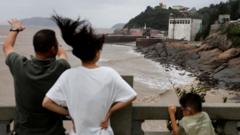
China Braces for Typhoon Bavi
China has been hit by Typhoon Bavi, marking the second typhoon to strike the country within a week. As a result, nearly two million residents have been evacuated from areas deemed vulnerable to the storm's impact. The typhoon initially landed in Taizhou city on Saturday evening, followed by a second landfall in Wenzhou around midnight.
After affecting remote parts of Japan and bringing heavy rainfall to Taiwan, Bavi has weakened to a severe tropical storm. However, it continues to pose significant risks due to its extensive rain bands. The storm, which spans 1,000 kilometers at its widest point, is anticipated to lose strength as it progresses northwest.
Impact Across Regions
The typhoon reached Hangzhou City in Zhejiang province by Sunday morning, according to reports from Chinese state media. Forecasts suggest it will move to eastern Anhui by Monday and approach the northern Yellow Sea near the Shandong Peninsula by Tuesday.
Authorities have evacuated over 1.7 million people in Zhejiang and additional thousands in adjacent provinces. The storm has led to the suspension of schools, work, and outdoor activities in Zhejiang. Additionally, 400 flights and numerous train services have been canceled.
Wenzhou, a city with a population of approximately 10 million, lies close to the storm's path, prompting the evacuation of hundreds of thousands of its residents. A local resident, Li Liangxing, described the situation, noting the sound of falling roof tiles and tree branches, which heightened the community's fear.
In an effort to minimize risk, Beijing ordered the evacuation of 100,000 people. Initially, Bavi began as a super typhoon, impacting Guam and the Northern Mariana Islands with winds reaching 290 km/h. As it traveled across the Pacific, it weakened and affected the Sakishima Islands in Japan, injuring five people and causing power outages.
Preparations and Precautions
While Taiwan avoided a direct hit from Bavi, the island experienced significant rainfall, leading to landslide warnings and the evacuation of thousands. Taiwanese authorities had cautioned that the typhoon could bring up to 1 meter of rainfall. The storm has also led to the cancellation of flights and the suspension of school classes in the region, as residents rushed to stock up on essential supplies.
Southern China is still recovering from Typhoon Maysak, which struck earlier in the week, resulting in 39 fatalities and substantial agricultural losses. Maysak also caused two rare tornadoes in central Hubei province, exacerbating the region's challenges.
Source: Original Article