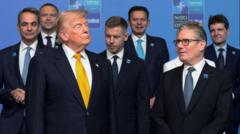
NATO Allies Commit to Major Missile Defense Project
A coalition of twelve NATO member countries, led by the United Kingdom, has announced plans to allocate more than £37 billion ($50 billion) over the next decade to develop a new long-range missile system. The initiative, known as the Deep Precision Strike project, was recently introduced by the UK government and will be a central topic at the NATO summit in Ankara, Turkey.
UK Prime Minister Sir Keir Starmer is attending his final NATO summit in this capacity, where he is expected to address criticism from U.S. President Donald Trump regarding defense spending commitments. Last year, NATO members agreed to increase defense spending to 5% of GDP by 2035. However, the UK has yet to present a plan to meet this target.
Objectives of the Missile Project
The Deep Precision Strike project aims to develop one of NATO's most advanced weapons systems, capable of striking targets at distances of up to 1,250 miles with high precision. Sir Keir Starmer has described the UK-led initiative as a means to unify European allies and maintain NATO's security for the foreseeable future.
Foreign Secretary Yvette Cooper highlighted the importance of this project given the increasingly perilous global environment. She emphasized the need for a reinforced Europe within a stronger NATO, adding that the project would not be operational until the 2030s.
U.S. Perspective and Defense Spending
In recent months, U.S. Defense Secretary Pete Hegseth announced a review of U.S. military presence in Europe, reflecting ongoing concerns about defense spending among NATO members. President Trump has persistently urged NATO countries to elevate their financial contributions to defense budgets.
Despite these pressures, the UK government remains committed to its Defense Investment Plan, which includes a £300 billion investment by 2030. Sir Keir Starmer has vowed to bolster the security of the UK and its allies, stating the need for a robust, Europe-focused NATO.
Concerns Over Russia
During the summit, Sir Keir is expected to address the threat posed by Russia, particularly in light of increased Russian military activity near UK waters and in European airspace. The UK government has reported a 30% surge in Russian military movements in these areas. Sir Keir will stress the necessity for NATO to be prepared to defend its members while avoiding direct confrontation with Russia.
Foreign Secretary Cooper added that the deep precision strike capability would enable the UK and its allies to target key military assets, thereby deterring potential aggressors and enhancing collective security.
Ukraine's Call for Support
Ukrainian President Volodymyr Zelensky used the summit platform to appeal for air defense systems to counter Russian aggression. Ukraine has increased its long-range strikes against Russian targets, which has led to significant disruptions in Russia's military logistics and operations.
The UK government recognized the effectiveness of such long-range systems, noting their ability to disrupt enemy forces significantly. Meanwhile, the Kremlin, through spokesman Dmitry Peskov, stated that Russia would closely monitor the developments at the Ankara summit. Peskov reiterated Russia's willingness to seek a political and diplomatic resolution to the conflict, despite perceiving the summit's discussions as confrontational.
Source: Original Article