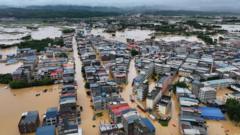
Severe Weather Strikes Southern China
Villagers in Renhe, located in Guangxi province in southern China, experienced severe flooding following the arrival of Typhoon Maysak over the weekend. Heavy rains began on Sunday, and by Monday morning, water levels had risen dramatically, inundating homes and forcing residents to flee without essential supplies. According to Zhou, a local resident, the rapid rise of floodwaters left them with little time to escape.
Typhoon Maysak has displaced tens of thousands of people in Guangxi, as swollen rivers and damaged dam walls led to widespread flooding. At least four people have died, and the city of Nanning, along with nearby villages, has been severely affected. To make matters worse, thunderstorms and tornadoes have also hit the central province of Hubei, located hundreds of kilometers away, resulting in 17 deaths and numerous injuries.
Government and Rescue Efforts
In response to the devastation caused by Typhoon Maysak, Chinese President Xi Jinping has called for comprehensive rescue and aid efforts. This typhoon marks the first major storm of the 2026 season to hit China, characterized by its sudden and intense winds. Another storm, Super Typhoon Bavi, is expected to reach China's eastern coast later in the week, potentially complicating recovery efforts with further heavy rainfall.
In Nanning, where floodwaters have inundated parts of the city, authorities have issued warnings about the potential for additional heavy rain that could hinder rescue operations. Residents across affected regions are facing significant challenges, including shortages of food and other essentials.
Impact on Local Communities
Reports from Guangxi describe thousands of individuals stranded on rooftops, with some areas receiving limited rescue services due to the scale of the disaster. Zhou, who has temporarily relocated to another province, shared that her family in Renhe remains trapped with dwindling food supplies, including a four-month-old niece who has gone without milk for over a day.
Huang, another resident from Yunbiao, recounted the rapid onset of flooding in her area, explaining that limited rescue resources and small lifeboats left many unable to reach safety. Communication remains difficult as internet, power, and other services are disrupted, isolating many from contact with their families.
Additionally, the floods have introduced new hazards, including escaping snakes from local farms, adding to the community's concerns.
Tornadoes and Extreme Weather in Hubei
Meanwhile, the central province of Hubei has seen at least two tornadoes form due to Typhoon Maysak. These tornadoes, a rarity in the region, have caused significant damage in cities like Ezhou and Huanggang. Videos shared on social media depict powerful winds and debris flying through the streets. In one harrowing incident, a man in Huanggang was injured after being blown out of his apartment by the tornado's force.
A student in Huanggang described the experience as terrifying, noting that many were injured from flying debris during what initially appeared to be a typical thunderstorm.
Broader Impact Across Northern China
Other regions in northern China are also coping with extreme weather conditions. Inner Mongolia's Tongliao city experienced a flash flood that resulted in two fatalities, while record rainfall in Fushun city led to three more deaths. The rainfall in Fushun shattered previous records, intensifying the challenges faced by these communities.
As rescue and recovery operations continue, residents remain anxious for news about their loved ones. Zhou recounted efforts to check on her family in Renhe, discovering that while they are safe, others in the area remain unaccounted for. Another resident from Gantang town is still awaiting word from her parents, who were last known to be seeking refuge on higher floors within their building.
Source: Original Article