Ukraine Escalates Attacks on Russian Maritime Routes
In a strategic move to disrupt Russian operations, Ukraine has intensified its attacks on maritime routes near the Russian-annexed Crimea. These efforts follow recent strikes on Russia's land corridors to the peninsula, with Ukrainian forces now focusing on maritime supply lines.
According to Robert Brovdi, the commander of Ukraine's drone force, also known by the codename Magyar, at least 36 ships have been targeted over the past four days in the Sea of Azov, which connects to the Black Sea via the Kerch Strait. Many of these vessels are part of Russia's "shadow fleet" of commercial oil tankers. While the exact number of affected ships remains uncertain, some may have been hit multiple times, and independent confirmations are pending.
Such losses are a significant setback to Russia's naval operations and President Vladimir Putin's assurances of fuel supply continuity.
Ukraine's "Logistics Lockdown" Strategy
This campaign is part of Ukraine's self-declared "logistics lockdown" aimed at cutting off supply lines to and from occupied Crimea. The presence of tankers near the north-eastern coast of Crimea is common due to an oil loading facility at Kerch port.
Following an attack on Kerch port last month, satellite imagery analyzed by BBC Verify showed a reduction in tanker numbers in the area in subsequent days. Nighttime footage of recent strikes has surfaced on social media, with Brovdi detailing attacks from July 6 to July 9.
Yuri Slyusar, governor of Russia's Rostov region, reported two empty tankers being attacked on Wednesday in Taganrog Bay, with the fires still burning the following day. Brovdi claimed the two tankers targeted earlier in the week were transporting approximately 7,000 tons of fuel from Taganrog to Crimea. A satellite image captured on Wednesday depicted a significant smoke plume from a ship about 2.5 miles off the Crimean coast, indicating ongoing fires since July 6.
Impact of Drone Attacks on Russian Maritime Operations
Data from NASA suggests these fires are linked to the initial wave of strikes by Ukraine's drone forces. The same imagery shows about 20 other ships leaving the area, heading south toward the Black Sea.
Among the targeted tankers, the Ukrainian Unmanned Systems Forces identified vessels such as Venera-3, Sanar-1, Sanar-17, Klimena, Thetis, Alexey Savrasov, and Penelopa. A passenger ferry, SKS One, and a bulk carrier were also attacked in Kerch port, with images shared on social media.
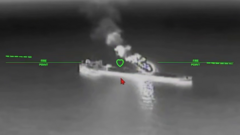
Leaving the Sea of Azov does not guarantee safety from Ukrainian drone attacks. Ukraine's general staff released footage of a naval drone strike on a sanctioned tanker named Blue, with the unmanned vessel approaching the tanker as gunfire was exchanged. Although the location was not confirmed, Ukraine stated the incident occurred near Yalta, a resort city in occupied Crimea.
Widespread Fuel Shortages in Russia
The attacks on these tankers coincide with ongoing strikes on Russian oil refineries, leading to widespread fuel shortages across Russia, including in Moscow and St. Petersburg. Ukrainian President Volodymyr Zelensky has justified these actions as responses to Russian strikes, emphasizing that Russians must recognize their state's involvement in the conflict.
Meanwhile, U.S. President Donald Trump described Ukraine's drone strategy as an escalation during his meeting with Zelensky at the NATO summit in Ankara. He noted that while it's an escalation, it could potentially lead to an end to the conflict.
The scope of drone strikes on Russian maritime logistics has increased notably in recent days. Brovdi reported attacks on 12 tankers in a single night from Wednesday to Thursday, with Russian pro-war sources not disputing the details or authenticity of the footage.
Criticisms have emerged from Russian channels about the lack of defense for these tankers, with some describing them as easy targets for Ukrainian drone operators. Mikhail Zvinchuk, author of the Telegram channel "Rybar," noted that the Black Sea Fleet has effectively confined itself to Novorossiysk.
These strikes are a significant blow, particularly given the declining oil refining capacity and fuel shortages in Crimea. In late June, Putin estimated Crimea's fuel needs at 70,000 tons per month and promised to secure supplies through land and sea routes. The attacked tankers in the Sea of Azov likely carried even more than that estimate.
Fuel rationing and shortages are now reported in over 90% of Russian regions, prompting a ban on diesel exports. Long queues have been observed at filling stations in major cities. In Crimea, Russian-appointed authorities face challenges in managing disruptions to power and transport supplies. Ukraine's military has already compromised Russia's land supply routes to the peninsula and is now targeting sea routes as well.
Source: Original Article