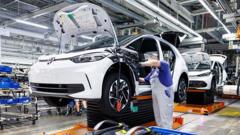
Volkswagen's Potential Job Cuts
The chief executive of Volkswagen Group, Oliver Blume, has announced that the company is considering cutting up to 100,000 jobs globally. This figure is significantly higher than the previously mentioned 50,000 job cuts, which were initially set to occur by 2030 in Germany alone. The move comes as the company struggles with declining profits, attributed to reduced sales in key markets and mounting competition from Chinese automotive brands entering Europe.
Rising Costs and Competitive Pressure
In a memo addressed to employees, Blume highlighted that Volkswagen's expenses are 20% higher than those of its competitors. To maintain competitiveness, the company must further reduce its costs. He noted that around 50,000 job cuts might be necessary worldwide but acknowledged that evaluations are underway to determine the exact number of feasible reductions across various brands and regions.
Blume emphasized the need for the company to enhance efficiency and simplicity to manage its expenditure effectively. He also mentioned that Volkswagen has been unable to repurpose four German factories previously threatened with closure, including those in Zwickau and Emden, which are currently involved in electric vehicle production. The facilities in Hanover and Neckarsulm are also considered costly to operate.
Profit Decline and Market Challenges
Volkswagen's financial performance has deteriorated over recent years. The group's operating profit fell from €22.6 billion in 2023 to €19.1 billion in 2024 and further declined to €8.9 billion last year. A significant factor has been the drop in sales within China, historically a lucrative market for Volkswagen, where sales declined by 26% in the first half of this year compared to the previous year. Additionally, a 7% reduction in U.S. sales occurred partly due to tariffs on car imports introduced by the Trump administration.
Concurrently, Chinese car manufacturers have been expanding into international markets, leveraging lower production costs and introducing innovative technologies. This has intensified pressure on established European automotive brands to control their costs while maintaining profitability.
Negotiations and Labor Relations
In late 2024, Volkswagen reached an agreement with the German trade union IG Metall to reduce 35,000 jobs at the core VW brand by 2030, with an additional 15,000 job cuts planned for other brands. These reductions were to occur in a "socially responsible manner." However, the current discussions suggest a more extensive scale of job reductions.
Recent protests have occurred at Volkswagen facilities in Germany, coinciding with a meeting of VW's supervisory board, which comprises both labor representatives and company executives. Some industry analysts speculate that the announcement of the potential 100,000 job cuts might be a strategic move by Volkswagen to influence negotiations, suggesting that the actual number of cuts may be lower.
Source: Original Article